Unit 3 · Repeating Pattern Sequence
Growing Figure Pattern — Count the Next Term
Lesson 2 of 2
Growing pattern questions take sequences to an entirely different level. Instead of repeating, each figure gets larger according to a mathematical rule — and you're asked about a figure so far along the sequence that you could never draw it. The key is finding the formula rather than counting term by term.
Figure growth questions appear regularly in OC TS at medium difficulty and are among the most elegant question types in the paper. Students who spot the algebraic relationship solve them in under thirty seconds; students who try to extend the pattern step-by-step run out of time at figure 367.
The examiner is checking whether you can recognise an invariant property — a quantity that remains constant across all figures regardless of how large n grows. The examiner deliberately uses a large figure number (like 367) to force students to find the general rule rather than compute directly.
A sequence of four or five figures is shown visually. Each figure contains multiple element types (squares and circles, triangles and lines, etc.) growing at different rates. You are asked about the relationship between the element counts at a very large figure number.
Best approach: Build a small table: count each element type for figures 1, 2, 3, 4. Compute the quantity the question asks for (here, squares minus circles) for each figure. If the result is the same every time, you have found an invariant — that value is your answer, no matter what figure number is asked about. Verify by writing the formula for each element type.
Question
See the figures below:
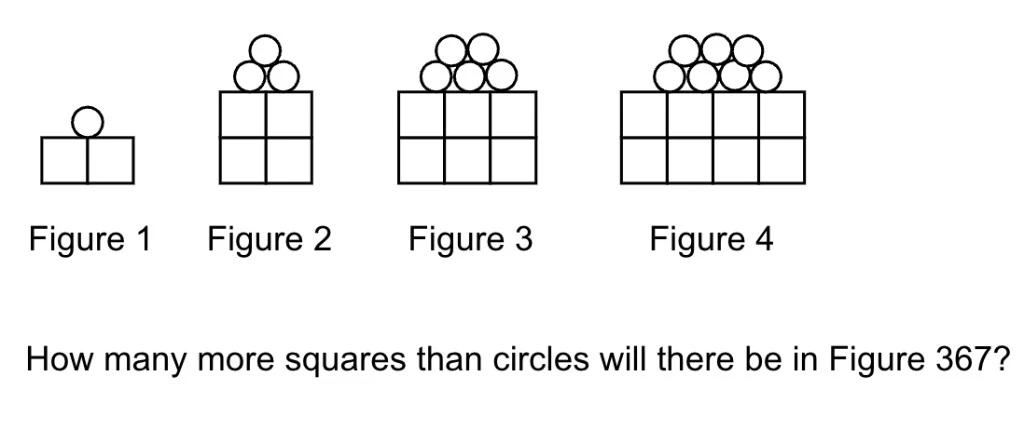
How many more squares than circles will there be in Figure 367?
Select an answer to see the explanation.
Give Your Child the Best Chance at OC Entry
Join NSW families preparing their children for the Opportunity Class Placement Test with the most realistic online OC practice tests available. First tests free—no credit card required.
Claim Your Free OC Practice Tests