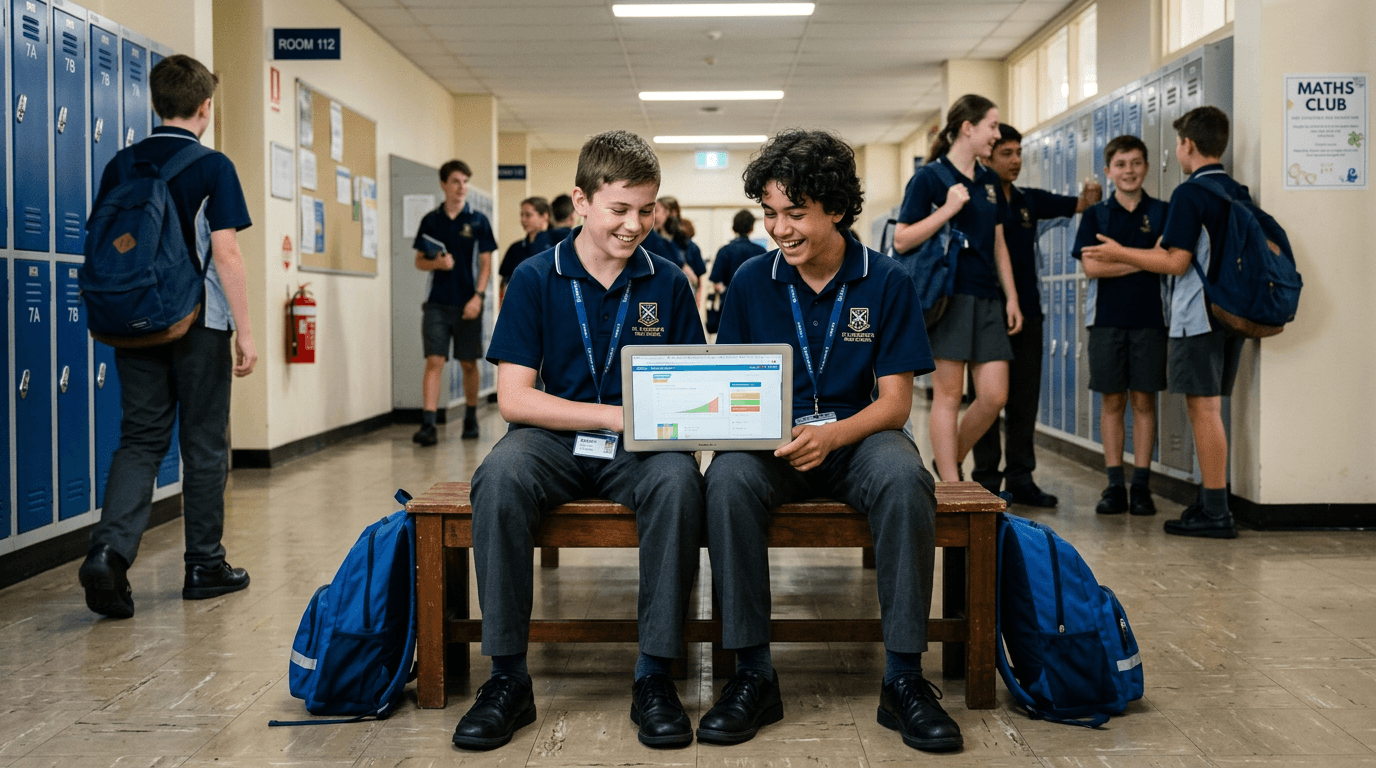
NSW Selective Practice Tests 2026: Master the New Digital Format — Selective online tests: preparation tips
By GoTestPrep
NSW Selective Test prep · Exam Strategy & Platform Hacks · 2 April 2026

By the GoTestPrep Educational Team · Updated: April 2026
Our guides are created by educators and test-prep specialists to help parents navigate the NSW High School Placement process. Please note: GoTestPrep is an independent educational platform and is not affiliated with the NSW Department of Education or Janison.
For parents in New South Wales, the journey toward securing a spot in a top-tier Selective High School can feel like navigating a maze. With the competition growing fiercer every year, the pressure to prepare effectively is immense. If your child is aiming for a placement in 2027 (sitting the exam in May 2026), the traditional methods of preparation are no longer enough.
The NSW Department of Education has finalised a massive shift in how students are assessed. The exam is now a fully computer-based test (CBT), featuring strict time limits and a perfectly balanced 25% weighting across all four subjects. To succeed today, students do not just need academic knowledge; they need digital test-day literacy and an intuitive understanding of the exam's unique logic.
In this comprehensive guide, we will explore why digital trial exams are non-negotiable for 2026, break down what your child will face in the four subject pillars, and demonstrate how to structure a winning preparation strategy.
1. The Digital Shift: Why Paper Preparation is Holding You Back
For decades, preparation involved stacks of photocopied PDFs and physical booklets. However, as outlined in the NSW Department of Education's official placement test information, students now sit the exam on provided devices using a specific digital interface (developed in partnership with Janison).
When a student sits down to take the official exam, they are not just battling the difficulty of the questions; they are battling the screen.
Paper vs. On-Screen Practice: A Comparison
| Feature | Traditional Paper Practice | Digital CBT Practice (The 2026 Reality) |
|---|---|---|
| Time management | Relies on wall clocks or parent supervision. | Built-in digital countdown timer forces internal pacing. |
| Navigation | Easy to flip pages back and forth. | Requires using on-screen "Next" and "Flag for Review" tools. |
| Writing section | Handwriting (allows for messy cross-outs). | Keyboard typing (requires 30–35 WPM speed and digital paragraph formatting). |
| Visual fatigue | Low eye strain. | High eye strain; requires "screen stamina" over 2.5 hours. |
| Our verdict | Good for early foundational learning. | Essential for the final 3–6 months of test preparation. |
Because the actual exam is entirely digital, relying solely on paper puts students at a severe disadvantage. To build genuine confidence, students must train in the exact environment they will be tested in. Timed selective-style practice on screen is the closest routine to exam day.
2. Why Authentic Mock Exams Are the Core of Success
Many parents fall into the trap of over-tutoring the theory while under-practising the application. It is one thing for a child to understand how to calculate the area of a circle; it is entirely another to solve a multi-step spatial reasoning puzzle with 60 seconds on a flashing digital timer.
High-quality online trial tests bridge the gap between theory and execution. Here is why they move the needle more than any other study method:
- Pacing and time management: The exam is an endurance event. With Thinking Skills and Mathematical Reasoning demanding an answer roughly every 60 seconds, students must develop a rhythm. Full-length mock exams force students to experience this pressure, teaching them when to guess, flag, and move on.
- Knowledge errors vs. execution errors: When a child gets a question wrong on a simulated test, detailed analytics reveal the true cause. Did they fail because they did not know the formula (a knowledge error), or because they misread the question under pressure (an execution error)?
- Desensitisation to anxiety: Test anxiety is the primary reason high-achieving students underperform. By exposing your child to hyper-realistic testing interfaces on weekends, the format becomes normalised.
3. Deep Dive: The Four Subject Pillars in 2026
Under the current rules, the exam features an equal 25% weighting for Reading, Writing, Mathematical Reasoning, and Thinking Skills. A student who excels in maths but struggles with typing an essay will find it difficult to secure a top-tier placement.
Here is exactly what your child must master, and how digital practice supports them.
Mathematical Reasoning (40 Minutes, 35 Questions)
According to the official test rules, calculators are strictly banned. However, the questions rarely require extreme arithmetic. The focus has shifted to application and logic.
Mock exams must challenge a student's ability to interpret complex word problems. A typical question might involve finding the procedural sequence to reach an outcome, interpreting data charts, or solving algebraic balances. Students must use their provided physical rough-working paper to draw diagrams while reading the digital screen. Practise under exam conditions with Mathematical Reasoning mock tests.
Thinking Skills (40 Minutes, 40 Questions)
This section assesses raw, uncoachable logic. With exactly 60 seconds per question, this is often the most brutal section for high achievers.
- Problem solving: Spatial reasoning (visualising 3D nets), seating arrangement deductions, and numerical patterns.
- Critical thinking: Detecting reasoning errors in a paragraph or determining which piece of new evidence would most strengthen a claim.
Build volume with Thinking Skills trial tests.
Reading (40 Minutes, 30 Questions)
The 2026 Reading paper demands far more than simple fact-finding. It evaluates a student's ability to read between the lines and understand authorial tone.
- The "cloze" format: The digital exam relies heavily on Dropdown Word Selection (Cloze passages). Students must choose the word that best fits the meaning and grammar in context.
Use Reading mock tests to rehearse on-screen comprehension and cloze-style tasks.
Writing (30 Minutes, 1 Prompt)
The Writing test is the only section marked by humans. The prompt could demand a narrative story, a persuasive essay, a discursive exploration, or a news article. Students must use an on-screen text box to type their response. Typing practice is mandatory. Writing mock tests let students draft and review in a digital workflow similar to test day.
4. How GoTestPrep Aligns with the Official Test
When searching for preparation materials, parents are often overwhelmed by generic PDFs or outdated portals using the 2019 syllabus.
At GoTestPrep, we have engineered a highly accurate simulation of the current NSW Selective Test format. While we are not affiliated with the test makers, our platform mirrors the structural and technological demands of exam day to ensure your child is not caught off guard.
A Hyper-Realistic Testing Interface
Our platform simulates the exact functionality of the CBT environment.
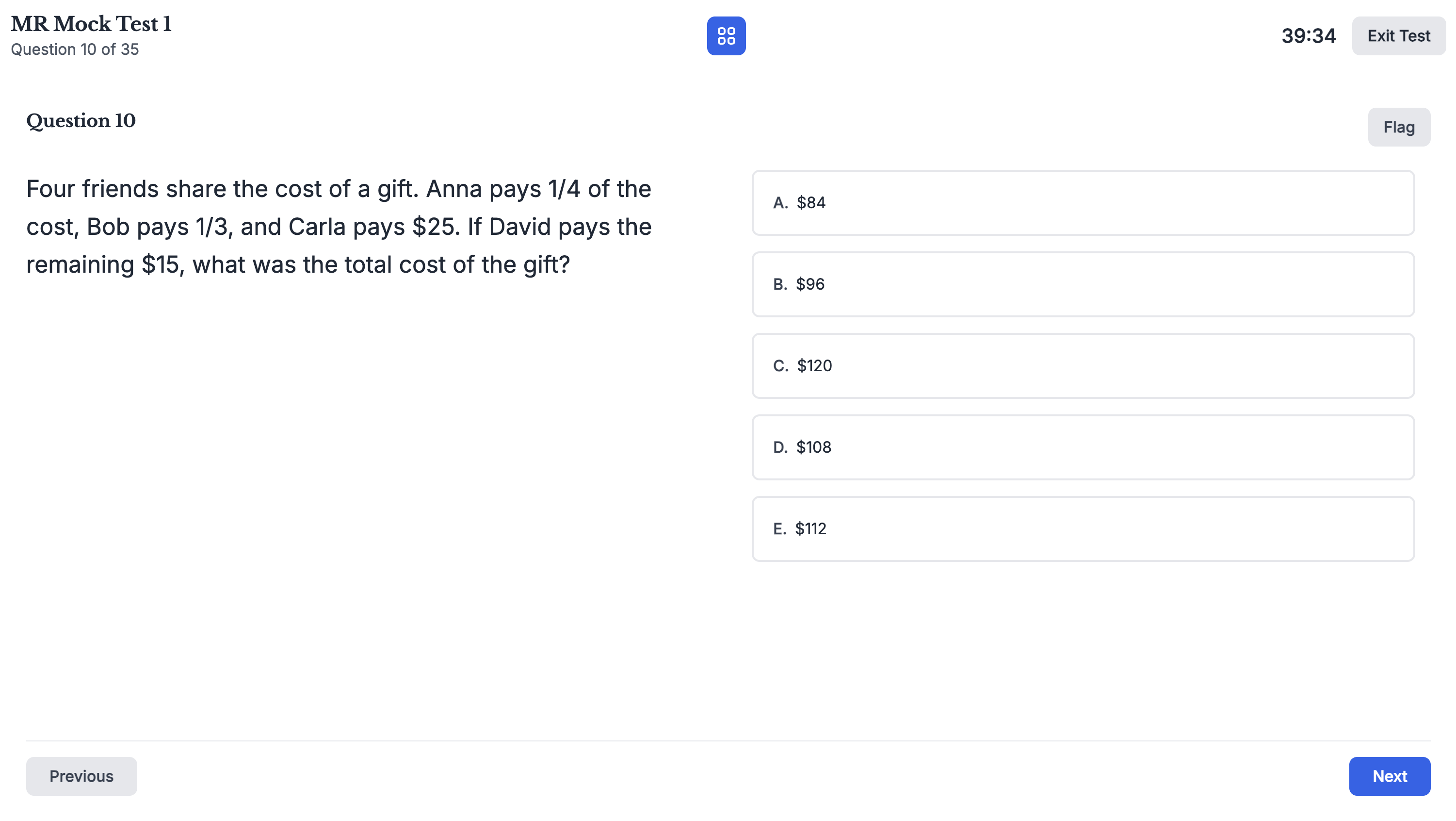
Mathematical Reasoning mock test on GoTestPrep: section timer (top right) and Flag button to mark questions for review—matching the pacing habits students need for the official CBT.
Students practise using the digital timer, navigating between questions, and utilising the "Flag" tool to skip and return to difficult logic puzzles—building the vital "screen stamina" they will need in May.
Comprehensive Analytics and Volume (As of April 2026)
Currently, GoTestPrep offers typical premium access that includes:
- 80 full-length, timed Selective trial tests across all four subjects.
- Over 2,500 practice questions with detailed, step-by-step solutions for every single problem.
- An advanced analytics dashboard that instantly identifies exactly where a student is dropping marks (e.g., spatial reasoning vs. fractions), allowing parents to retarget weak areas efficiently.
5. A 4-Week Strategic Study Plan
Having access to premium mock exams is an incredible advantage, but they must be used strategically. Here is how to deploy your GoTestPrep trial effectively over a four-week sprint:
- Week 1 (Diagnostic): Take one full, timed mock test for each of the four subjects. Let the analytics dashboard reveal their baseline strengths and weaknesses.
- Week 2 (Micro-drilling): Use the untimed practice sets to target specific weaknesses identified in Week 1 (e.g., if Cloze passages were weak, drill only those).
- Week 3 (Time management): Return to full-length timed trials. Train the "60-second rhythm." If a question takes too long, force them to use the digital Flag button.
- Week 4 (Desensitisation): In the final weekend before the exam, run a complete "Mock Exam Day." Sit all four tests back-to-back, simulating the exact breaks of the real test.
6. Frequently Asked Questions (2026 Test)
When is the 2026 NSW Selective Test?
The test is typically held in early May for Year 7 entry the following year. For the 2027 intake, official dates are published by the Department; your child's Test Admission Ticket confirms which day they sit. The Department currently lists Friday 1 – Saturday 2 May 2026 for the main selective high school test window (students attend one day only). Always confirm on the NSW placement test dates page and your dashboard.
Are calculators allowed in the Mathematical Reasoning section?
No. Calculators, smartwatches, and own rulers are strictly prohibited on the official checklist. Students are provided with blank paper for rough working out. See the test day checklist on the Department site.
Is doing paper practice enough for 2026?
While paper worksheets are fine for learning early concepts, they are insufficient for the final months of preparation. The test is 100% digital, meaning students must be comfortable managing screen fatigue, typing their writing task, and using digital navigation tools.
What does the 25% weighting mean?
Previously, the test favoured mathematics heavily. Now, Reading, Writing, Mathematical Reasoning, and Thinking Skills are each worth exactly 25% of the total score. A balanced performance is essential.
Secure Your Child's Advantage Today
The path to a top-tier Selective High School requires moving away from outdated methodologies and embracing the digital reality of the modern test. Success hinges on familiarity, endurance, and precise execution under pressure.
Equip your child with an accurate, analytics-driven simulation. Experience the interface for yourself by exploring our free trial (no payment details required) to see how GoTestPrep can build your child's confidence for exam day.
Start your free trial on GoTestPrep
Sources and Further Reading
- NSW Department of Education — Selective high school placement test (structure, dates, computer-based delivery)
- NSW Department of Education — Test day checklist and what to expect (what to bring, rules, breaks)