Thinking Skills Mock Test 9: 2027 NSW Selective Format

Master the new Janison-style Thinking Skills exam with our comprehensive 40-question mock test. Designed specifically for students targeting top-tier NSW Selective High Schools.

Duration

40 Minutes

Format

2027 NSW Format

Questions

40 multiple-choice

Level

Official Selective Test Level

Skills Covered in this Test

This mock test mirrors the official weightings of the NSW Department of Education exam.

The breakdown

  • Finding Procedures: Identifying the correct sequence or steps to reach an outcome.
  • Additional Evidence: Strengthening and weakening arguments with new information.
  • Spatial Reasoning: Visualising and manipulating shapes, positions, and arrangements.
  • Seating Arrangements: Deducing who sits where from ordering and constraint clues.
  • Drawing a Conclusion: Logic-based deduction and inference from given premises.
  • Matching Arguments: Recognising argument structures that are parallel or equivalent.

Sample Questions from Test 9

The first two questions of this mock test (same order and wording as the timed exam).

Thinking Skills

Use the following image to answer questions 2 and 3.

Question 1 · Multiple choice

Question

Use the following image to answer questions 2 and 3.

A series of triangles are made by joining together smaller black and white triangles.

How many upside down triangles would Triangle 10 have?
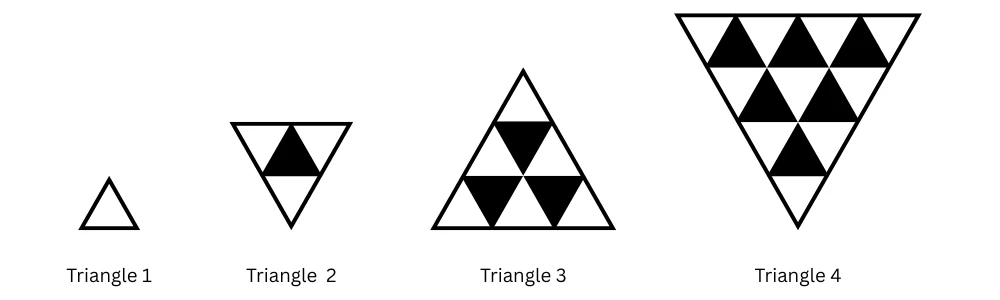
Growing triangle pattern made of smaller black and white triangles

Options

  • A.55
  • B.56
  • C.57
  • D.58

Correct answer

A.55

Explanation

Step 1 — Count upside-down triangles in each triangle from the image.

TriangleUpside-down (∇) triangles
Triangle 10
Triangle 21
Triangle 33
Triangle 46

Step 2 — Find how the sequence grows.

Look at how many are ADDED each time:

0 → 1 (add 1) 1 → 3 (add 2) 3 → 6 (add 3) 6 → 10 (add 4) 10 → 15 (add 5) …

Each step, the number added goes up by 1. These are the triangular numbers.

Step 3 — Continue to Triangle 10.

TriangleAddTotal
5+410
6+515
7+621
8+728
9+836
10+945
11+1055

Following this pattern to find the answer for Triangle 10: 55

Answer: 55

Thinking Skills

A standard die has faces numbered 1–6 with no repeats. Opposite faces always add up to 7 (so 1 is opposite 6,…

Question 2 · Multiple choice

Question

A standard die has faces numbered 1–6 with no repeats. Opposite faces always add up to 7 (so 1 is opposite 6, 2 is opposite 5, and 3 is opposite 4).

When a die rests on a table, you can see three faces at once (for example: left, front, and top).

Which group of three face numbers is possible to see at the same time?

Options

  • A.1, 3, and 5
  • B.2, 5, and 3
  • C.1, 6, and 4
  • D.2, 4, and 5

Correct answer

A.1, 3, and 5

Explanation

Step 1: Understand the key rule.

On a standard die, opposite faces always add up to 7. This gives three opposite pairs:

Opposite pairSum
1 and 61 + 6 = 7
2 and 52 + 5 = 7
3 and 43 + 4 = 7

Two faces that are opposite can never both be visible at the same time — one always faces down (hidden) while the other faces up or sideways.

Step 2: Check each group of three.

When the die rests on a table, you see three faces (left, front, top). None of the three can be opposite to another in the visible group.

Group A: {1, 3, 5}

  • 1's opposite is 6 (not in the group)
  • 3's opposite is 4 (not in the group)
  • 5's opposite is 2 (not in the group)

No opposite pairs among the three faces. This is possible!

Group B: {2, 5, 3}

  • 2 and 5 are opposite (2 + 5 = 7). Impossible — cannot both be visible. ✗

Group C: {1, 6, 4}

  • 1 and 6 are opposite (1 + 6 = 7). Impossible

Group D: {2, 4, 5}

  • 2 and 5 are opposite (2 + 5 = 7). Impossible

Only {1, 3, 5} is possible to see at the same time.

Core Competencies

Additional EvidenceData SufficiencyDetecting Reasoning ErrorsDrawing a ConclusionEvaluating HypothesesFinding ProceduresIdentifying SimilarityLogical DeductionMatching ArgumentsRelevant SelectionsSeating ArrangementsSpatial ReasoningSyllogismsTruth/Liar Puzzles

Prepare with Precision

  • Boost speed and accuracy in high-pressure tests.
  • Get comfortable with the Janison-style interface.
  • Identify your key areas for improvement.

This public page is designed so students and parents get rich, accurate information about the test structure and skills assessed. The full timed mock—including the rest of the 40 questions, scoring, and detailed review—is available to enrolled members after sign-in, matching how premium preparation platforms balance discoverability with protected content.