Thinking Skills Mock Test 5: 2027 NSW Selective Format

Master the new Janison-style Thinking Skills exam with our comprehensive 40-question mock test. Designed specifically for students targeting top-tier NSW Selective High Schools.

Duration

40 Minutes

Format

2027 NSW Format

Questions

40 multiple-choice

Level

Official Selective Test Level

Skills Covered in this Test

This mock test mirrors the official weightings of the NSW Department of Education exam.

The breakdown

  • Matching Arguments: Recognising argument structures that are parallel or equivalent.
  • Additional Evidence: Strengthening and weakening arguments with new information.
  • Identifying Similarity: Pattern and structure comparison across cases.
  • Syllogisms: Applying categorical logic and valid inference forms.
  • Evaluating Hypotheses: Assessing whether evidence supports or undermines a hypothesis.
  • Logical Deduction: Drawing necessary conclusions from given rules and conditions.

Sample Questions from Test 5

The first two questions of this mock test (same order and wording as the timed exam).

Thinking Skills

The diagram shows a 6×6 grid of equal cells. A cell is shaded when row + column (counting from 1 in the top-l…

Question 1 · Multiple choice

Question

The diagram shows a 6×6 grid of equal cells. A cell is shaded when row + column (counting from 1 in the top-left) is even; otherwise it is unshaded.

Options

How many shaded cells are there in total?

  • A.16
  • B.17
  • C.18
  • D.19

Correct answer

C.18

Explanation

Step 1: Understand the shading rule.

A cell is shaded when (row number + column number) is even. Using a few examples in Row 1:

RowColRow+ColEven?Shaded?
112Yes
123No
134Yes
145No

This creates a checkerboard pattern — every other cell is shaded, starting shaded in Row 1.

Step 2: Count shaded cells row by row.

In a 6-column row, exactly 3 out of 6 cells are shaded:

RowPatternShaded
Row 1■ □ ■ □ ■ □3
Row 2□ ■ □ ■ □ ■3
Row 3■ □ ■ □ ■ □3
Row 4□ ■ □ ■ □ ■3
Row 5■ □ ■ □ ■ □3
Row 6□ ■ □ ■ □ ■3

Step 3: Find the total.

Total shaded = 6 rows × 3 shaded per row = 18 cells

(This is also exactly half of the total 36 cells, which always happens on an even × even checkerboard.)

Answer: 18
Thinking Skills

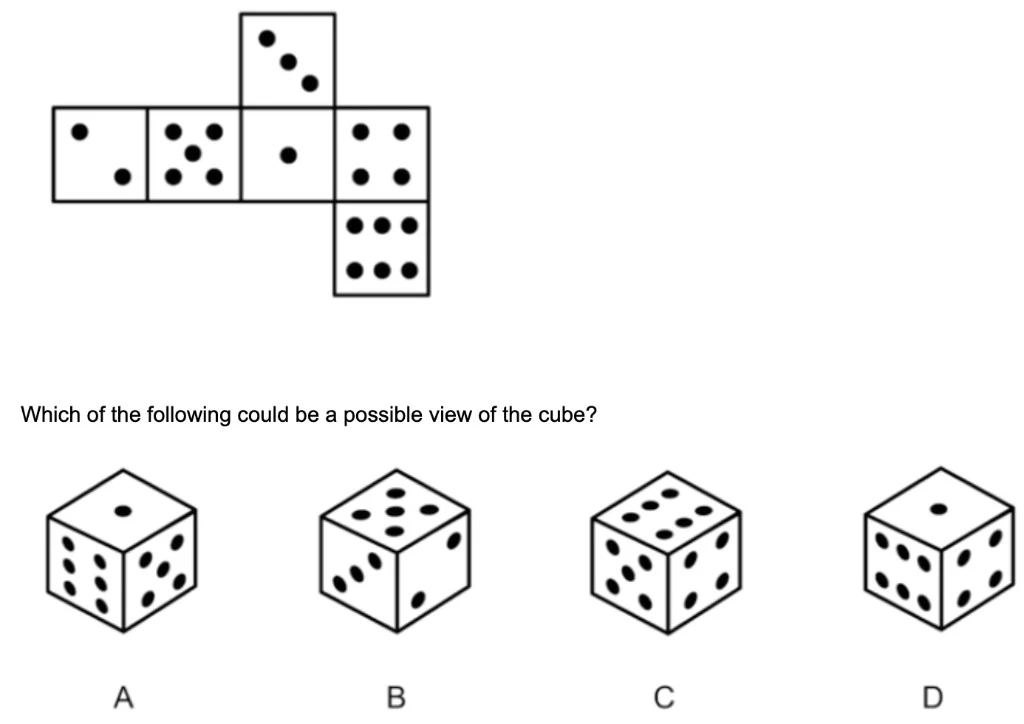
A net of a cube is shown below.

Question 2 · Multiple choice

Question

A net of a cube is shown below.

Which of the following could be a possible view of the cube?

A cross-shaped dice cube net showing faces 1–6; four labelled 3D dice views (options A–D)

Options

  • A.A
  • B.B
  • C.C
  • D.D

Correct answer

B.B

Explanation

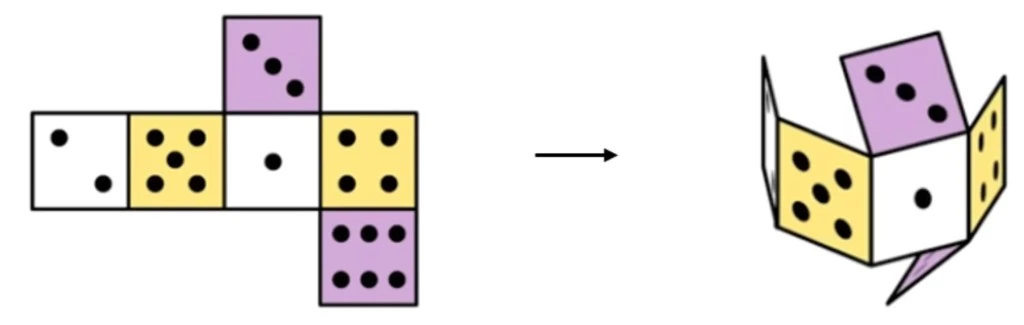
Step 1 — Work out the opposite face pairs

When we fold the net into a cube, each pair of faces that end up facing away from each other are called opposite faces. Opposite faces can never both be seen in a single 3D view.

Coloured net folding into a cube showing opposite-face pairs

As shown above:

  • 4 and 5 are opposite each other
  • 1 and 2 are opposite each other
  • 3 and 6 are opposite each other

Step 2 — Eliminate Option C

Option C shows both 4 dots and 5 dots visible in the same view. But we just found that 4 and 5 are opposite faces — impossible to see at the same time. Option C is eliminated.


Step 3 — Eliminate Option D

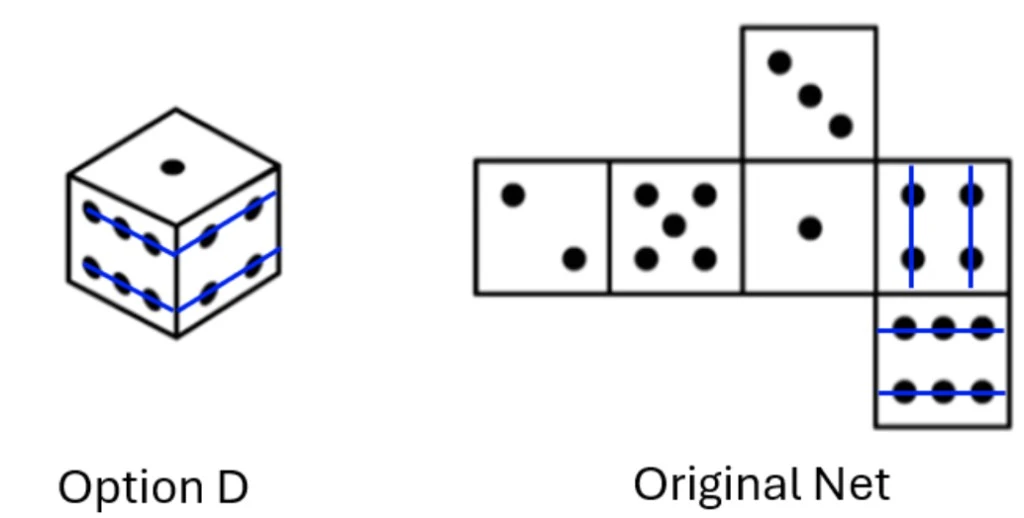
In Option D, the 6-dot face and the 4-dot face both have their rows of dots running in the same direction (horizontal). But in the original net, those two faces meet at a corner where their dot rows are perpendicular to each other.

Option D versus the original net showing the dot-row orientation mismatch

Option D is eliminated.


Step 4 — Eliminate Option A

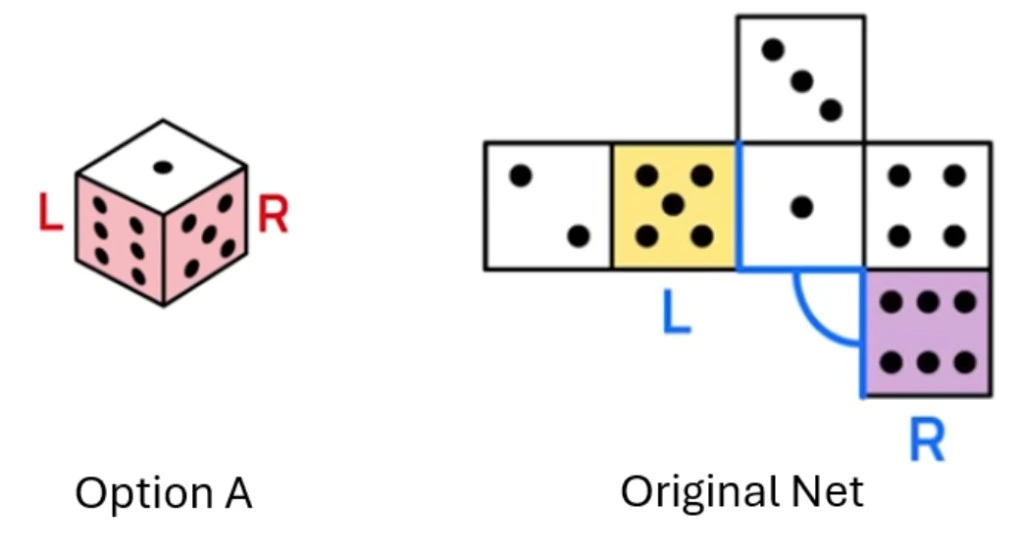
Option A shows the 1-dot face on top, with the 6-dot face on the left and the 5-dot face on the right.

However, reading from the net: when the 1-dot face is on top, the 5-dot face is on the left and the 6-dot face is on the right — the opposite of what Option A shows.

Option A versus the original net showing the left–right swap

Option A is eliminated.


Step 5 — Only Option B remains

Options A, C, and D have all been eliminated, so Option B must be the correct answer.

Core Competencies

Additional EvidenceData SufficiencyDetecting Reasoning ErrorsDrawing a ConclusionEvaluating HypothesesFinding ProceduresIdentifying SimilarityLogical DeductionMatching ArgumentsRelevant SelectionsSeating ArrangementsSpatial ReasoningSyllogismsTruth/Liar Puzzles

Prepare with Precision

  • Boost speed and accuracy in high-pressure tests.
  • Get comfortable with the Janison-style interface.
  • Identify your key areas for improvement.

This public page is designed so students and parents get rich, accurate information about the test structure and skills assessed. The full timed mock—including the rest of the 40 questions, scoring, and detailed review—is available to enrolled members after sign-in, matching how premium preparation platforms balance discoverability with protected content.