Thinking Skills Mock Test 14: 2027 NSW Selective Format

Master the new Janison-style Thinking Skills exam with our comprehensive 40-question mock test. Designed specifically for students targeting top-tier NSW Selective High Schools.

Duration

40 Minutes

Format

2027 NSW Format

Questions

40 multiple-choice

Level

Official Selective Test Level

Skills Covered in this Test

This mock test mirrors the official weightings of the NSW Department of Education exam.

The breakdown

  • Detecting Reasoning Errors: Identifying flaws, assumptions, and gaps in arguments.
  • Relevant Selections: Choosing the option that best supports or completes an argument.
  • Identifying Similarity: Pattern and structure comparison across cases.
  • Syllogisms: Applying categorical logic and valid inference forms.
  • Logical Deduction: Drawing necessary conclusions from given rules and conditions.
  • Evaluating Hypotheses: Assessing whether evidence supports or undermines a hypothesis.

Sample Questions from Test 14

The first two questions of this mock test (same order and wording as the timed exam).

Thinking Skills

In a survey of gamers, everyone who liked GameBox liked PlayCube. Everyone who liked PlayCube liked FlexConso…

Question 1 · Multiple choice

Question

In a survey of gamers, everyone who liked GameBox liked PlayCube. Everyone who liked PlayCube liked FlexConsole, but no one who liked PlayCube liked Computer. Darren, Arjunda, Lee and Zara all took part in the survey.

Options

Based on the information, which one of the following must be true?

  • A.If Zara likes GameBox, she does not like Computer.
  • B.If Arjunda does not like Computer, she does not like FlexConsole.
  • C.If Lee does not like GameBox, he does not like PlayCube.
  • D.If Darren likes FlexConsole, he also likes PlayCube.

Correct answer

A.If Zara likes GameBox, she does not like Computer.

Explanation

Step 1 — Map out the logical chain.

GameBox  →  PlayCube  →  FlexConsole
                 ↕
             NOT Computer
(anyone who likes PlayCube does NOT like Computer)

Rules:

  • GameBox → PlayCube (everyone who liked GameBox liked PlayCube)
  • PlayCube → FlexConsole (everyone who liked PlayCube liked FlexConsole)
  • PlayCube → NOT Computer (no one who liked PlayCube liked Computer)

Step 2 — Test option A about Zara.

"If Zara likes GameBox, she does not like Computer."

Follow the chain:

  1. Zara likes GameBox → she MUST like PlayCube (Rule 1)
  2. She likes PlayCube → she CANNOT like Computer (Rule 3)

This conclusion MUST be true — it follows directly from two definite rules. ✓

Answer: A — If Zara likes GameBox, she does not like Computer
Thinking Skills

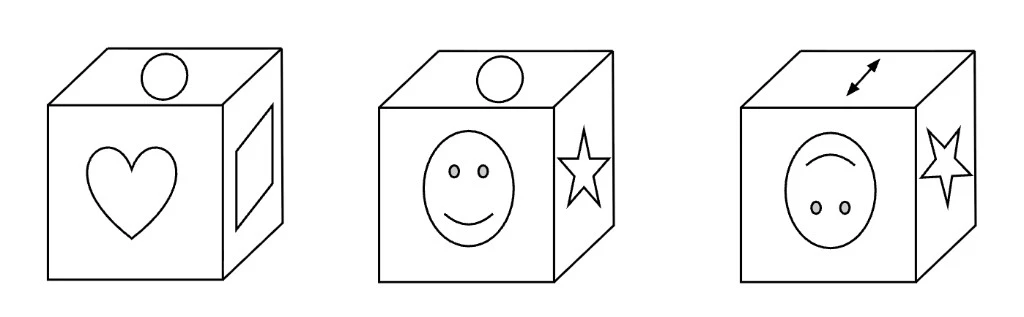
Three views of a cube are shown below. Which shape is on the opposite side of the heart?

Question 2 · Multiple choice

Question

Three views of a cube are shown below. Which shape is on the opposite side of the heart?

Three isometric views of the same cube. View 1: small circle on top, heart on front, rectangle on right. View 2: small circle on top, smiley face on front, star on right. View 3: double-headed arrow on top, oval face on front, star on right.

Options

  • A.Double-headed arrow
  • B.Smiley face
  • C.Star
  • D.Circle

Correct answer

B.Smiley face

Explanation

The small circle appears on top in both Views 1 and 2, so the cube was rotated around its vertical axis between those two views (the top stayed fixed).

When you rotate a cube 180° around the vertical axis, the front face moves to the back. View 1 shows the heart on the front. After a 180° turn, the face that was at the back comes to the front — and View 2 shows the smiley face there. So the smiley face was directly behind the heart in View 1.

Heart and smiley face are on opposite sides.

Checking the other options:

  • A (double-headed arrow): this appears on top in View 3 — it cannot be opposite the heart. ✗
  • C (star): visible on the right in Views 2 and 3 — not opposite the heart. ✗
  • D (circle): on top in Views 1 and 2 — not opposite the heart. ✗
  • B (smiley face) ✓

Core Competencies

Additional EvidenceData SufficiencyDetecting Reasoning ErrorsDrawing a ConclusionEvaluating HypothesesFinding ProceduresIdentifying SimilarityLogical DeductionMatching ArgumentsRelevant SelectionsSeating ArrangementsSpatial ReasoningSyllogismsTruth/Liar Puzzles

Prepare with Precision

  • Boost speed and accuracy in high-pressure tests.
  • Get comfortable with the Janison-style interface.
  • Identify your key areas for improvement.

This public page is designed so students and parents get rich, accurate information about the test structure and skills assessed. The full timed mock—including the rest of the 40 questions, scoring, and detailed review—is available to enrolled members after sign-in, matching how premium preparation platforms balance discoverability with protected content.