Thinking Skills Mock Test 13: 2027 NSW Selective Format

Master the new Janison-style Thinking Skills exam with our comprehensive 40-question mock test. Designed specifically for students targeting top-tier NSW Selective High Schools.

Duration

40 Minutes

Format

2027 NSW Format

Questions

40 multiple-choice

Level

Official Selective Test Level

Skills Covered in this Test

This mock test mirrors the official weightings of the NSW Department of Education exam.

The breakdown

  • Additional Evidence: Strengthening and weakening arguments with new information.
  • Truth/Liar Puzzles: Identifying truth-tellers and liars from statements and constraints.
  • Data Sufficiency: Deciding if given information is enough to answer the question.
  • Finding Procedures: Identifying the correct sequence or steps to reach an outcome.
  • Drawing a Conclusion: Logic-based deduction and inference from given premises.
  • Matching Arguments: Recognising argument structures that are parallel or equivalent.

Sample Questions from Test 13

The first two questions of this mock test (same order and wording as the timed exam).

Thinking Skills

On a standard die, opposite faces always add to 7.

Question 1 · Multiple choice

Question

On a standard die, opposite faces always add to 7.

Which pair of numbers could not appear on adjacent faces (faces that share an edge) of a real standard die?

Options

  • A.1 and 4
  • B.2 and 5
  • C.3 and 6
  • D.1 and 3

Correct answer

B.2 and 5

Explanation

On a standard die, opposite faces add to 7, so the opposite pairs are:

  • 1 is opposite 6
  • 2 is opposite 5
  • 3 is opposite 4

Opposite faces are directly across from each other — they can never share an edge.

Check each option:

  • 1 and 4: not an opposite pair → they can be adjacent ✓
  • 2 and 5: they ARE opposite → they cannot be adjacent ✗ ← answer
  • 3 and 6: not an opposite pair → they can be adjacent ✓
  • 1 and 3: not an opposite pair → they can be adjacent ✓
Thinking Skills

In a survey, 28 respondents were asked if they booked holidays using travel planners, travel websites or othe…

Question 2 · Multiple choice

Question

In a survey, 28 respondents were asked if they booked holidays using travel planners, travel websites or other booking methods.

15 respondents used travel planners.

Five respondents used all the three methods.

40% of the respondents who used travel planners but did not use travel websites, used other booking methods.

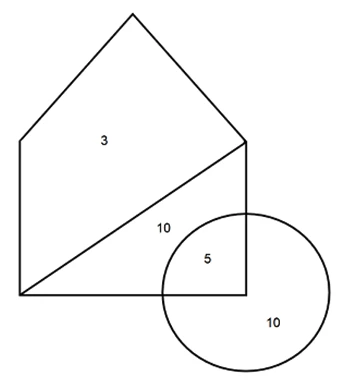
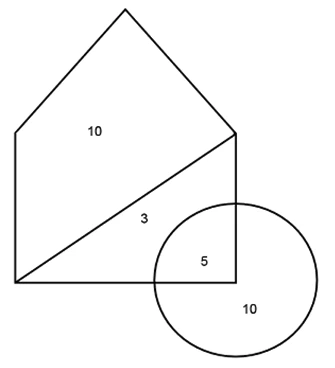
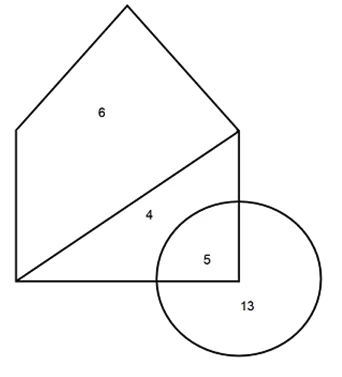
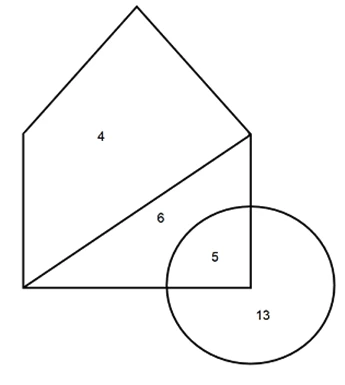
If the pentagon, circle and triangle represent respondents who used travel planners, travel websites and other booking methods respectively, which diagram best represents the above data?

Options

  • A.ADiagram A: pentagon regions showing 10 and 3, overlapping circle showing 5 and 10
  • B.BDiagram B: pentagon regions showing 6 and 4, overlapping circle showing 5 and 13
  • C.CDiagram C: pentagon regions showing 4 and 6, overlapping circle showing 5 and 13
  • D.DDiagram D: pentagon regions showing 3 and 10, overlapping circle showing 5 and 10

Correct answer

B.BDiagram B: pentagon regions showing 6 and 4, overlapping circle showing 5 and 13

Explanation

The correct answer is Diagram B.

Here is a step-by-step breakdown of how to solve this puzzle using the clues provided.

Step 1: Understand what the shapes mean

  • Pentagon (large house shape) = People who used travel planners
  • Circle = People who used travel websites
  • Triangle = People who used other booking methods

Step 2: Use the first clue to narrow down the options

Clue: 15 respondents used travel planners.

All numbers inside the Pentagon must add up to exactly 15. Let's test each diagram:

  • Diagram A: 10 + 3 + 5 = 18 ✗
  • Diagram B: 6 + 4 + 5 = 15 ✓
  • Diagram C: 4 + 6 + 5 = 15 ✓
  • Diagram D: 3 + 10 + 5 = 18 ✗

The answer must be either Diagram B or Diagram C.

Step 3: Use the percentage clue to find the winner

Clue: 40% of respondents who used travel planners but did NOT use travel websites, used other booking methods.

Breaking this down:

  1. "Used travel planners but not travel websites" = inside the Pentagon, outside the Circle.

    • Both Diagram B and C have 6 + 4 = 10 people in this region.
  2. 40% of these 10 people used other booking methods:

    • 40% of 10 = 4 people

This means exactly 4 people must appear inside the Triangle (other booking methods) region.

  • Diagram B has 4 inside the Triangle. ✓
  • Diagram C has 6 inside the Triangle. ✗

Diagram B is correct!

Step 4: Final Check

The survey had 28 respondents total. Adding all numbers in Diagram B:

6 + 4 + 5 + 13 = 28

The maths works out perfectly.

Core Competencies

Additional EvidenceData SufficiencyDetecting Reasoning ErrorsDrawing a ConclusionEvaluating HypothesesFinding ProceduresIdentifying SimilarityLogical DeductionMatching ArgumentsRelevant SelectionsSeating ArrangementsSpatial ReasoningSyllogismsTruth/Liar Puzzles

Prepare with Precision

  • Boost speed and accuracy in high-pressure tests.
  • Get comfortable with the Janison-style interface.
  • Identify your key areas for improvement.

This public page is designed so students and parents get rich, accurate information about the test structure and skills assessed. The full timed mock—including the rest of the 40 questions, scoring, and detailed review—is available to enrolled members after sign-in, matching how premium preparation platforms balance discoverability with protected content.