Thinking Skills Mock Test 10: 2027 NSW Selective Format

Master the new Janison-style Thinking Skills exam with our comprehensive 40-question mock test. Designed specifically for students targeting top-tier NSW Selective High Schools.

Duration

40 Minutes

Format

2027 NSW Format

Questions

40 multiple-choice

Level

Official Selective Test Level

Skills Covered in this Test

This mock test mirrors the official weightings of the NSW Department of Education exam.

The breakdown

  • Drawing a Conclusion: Logic-based deduction and inference from given premises.
  • Detecting Reasoning Errors: Identifying flaws, assumptions, and gaps in arguments.
  • Relevant Selections: Choosing the option that best supports or completes an argument.
  • Truth/Liar Puzzles: Identifying truth-tellers and liars from statements and constraints.
  • Logical Deduction: Drawing necessary conclusions from given rules and conditions.
  • Finding Procedures: Identifying the correct sequence or steps to reach an outcome.

Sample Questions from Test 10

The first two questions of this mock test (same order and wording as the timed exam).

Thinking Skills

"There are no Olympic swimmers that are not fit, nor are there any gymnasts that are Olympic swimmers."

Question 1 · Multiple choice

Question

"There are no Olympic swimmers that are not fit, nor are there any gymnasts that are Olympic swimmers."

Options

Which of the following must be true?

  • A.Gymnasts are all fit.
  • B.Any fit person is also a gymnast.
  • C.No Olympic swimmers are gymnasts.
  • D.All of the above.

Correct answer

C.No Olympic swimmers are gymnasts.

Explanation

Step 1 — Unpack the two parts of the statement.

"There are no Olympic swimmers that are not fit" → This means: ALL Olympic swimmers ARE fit.

"nor are there any gymnasts that are Olympic swimmers" → This means: NO gymnast is also an Olympic swimmer. (Gymnasts and Olympic swimmers are completely separate groups.)

Step 2 — Find what MUST be true.

From part 2 of the statement, directly:

  • There is NO gymnast who is an Olympic swimmer.
  • Equivalently: There is NO Olympic swimmer who is a gymnast.

Answer: C — No Olympic swimmers are gymnasts

This is the only statement that must be true. It is directly stated in the original sentence.
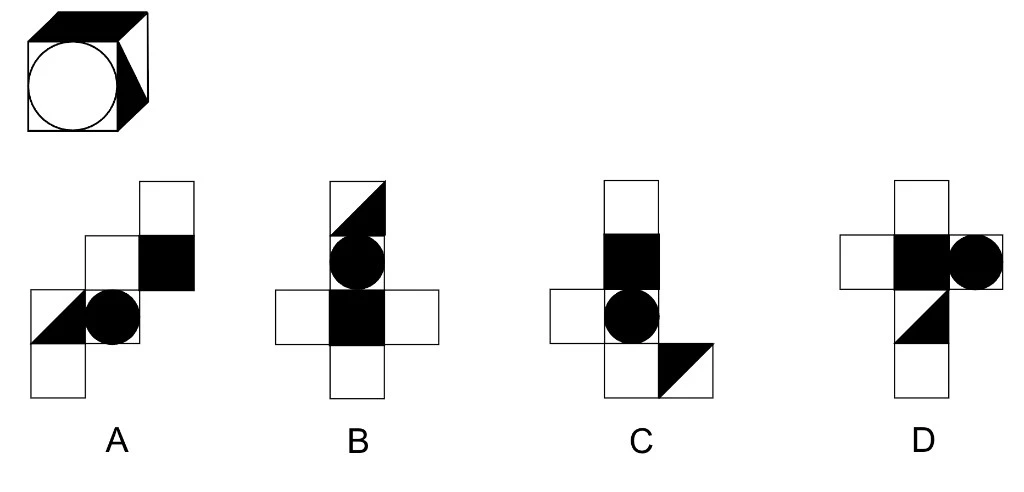
Thinking Skills

The diagram shows a cubic paper box with a triangle, a square and a circle on its three faces. Using a pair o…

Question 2 · Multiple choice

Question

The diagram shows a cubic paper box with a triangle, a square and a circle on its three faces. Using a pair of scissors to cut along its edges to form a plane figure, the net obtained could be ( ).

Question image

Options

  • A.A
  • B.B
  • C.C
  • D.D

Correct answer

B.B

Explanation

Mentally unfold the cube by cutting along its edges.

The 3D cube shows three visible faces:

  • Front face: large circle
  • Top-right face: black triangle (diagonal half)
  • Right face: black square

When the cube is unfolded into a flat net, the three symbols must appear on faces that are adjacent in the correct relative positions.

Option B is the valid net: it is a cross-shaped arrangement where the triangle, circle and black square are positioned on faces that correctly fold up to match the original cube — the circle and square are on opposite sides of the vertical column, and the triangle sits at the top.

Options A, C and D place the symbols in positions that cannot fold back into the original cube configuration.

Core Competencies

Additional EvidenceData SufficiencyDetecting Reasoning ErrorsDrawing a ConclusionEvaluating HypothesesFinding ProceduresIdentifying SimilarityLogical DeductionMatching ArgumentsRelevant SelectionsSeating ArrangementsSpatial ReasoningSyllogismsTruth/Liar Puzzles

Prepare with Precision

  • Boost speed and accuracy in high-pressure tests.
  • Get comfortable with the Janison-style interface.
  • Identify your key areas for improvement.

This public page is designed so students and parents get rich, accurate information about the test structure and skills assessed. The full timed mock—including the rest of the 40 questions, scoring, and detailed review—is available to enrolled members after sign-in, matching how premium preparation platforms balance discoverability with protected content.