OC Thinking Skills Practice Test 4 — 2027 NSW Opportunity Class Exam

Sharpen deductive logic, argument evaluation, and analytical reasoning with this 30-question OC Thinking Skills practice test. Matched to the 2027 NSW Opportunity Class Placement Test format and timed to build real exam speed for Year 4/5 students.

Duration

30 Minutes

Format

2027 NSW Format

Questions

30 multiple-choice

Level

NSW OC Placement Test Level

Skills Covered in this Test

This practice test mirrors the official weightings of the NSW Department of Education exam.

The breakdown

  • Drawing a Conclusion: Logic-based deduction and inference from given premises.
  • Detecting Reasoning Errors: Identifying flaws, assumptions, and gaps in arguments.
  • Relevant Selections: Choosing the option that best supports or completes an argument.
  • Truth/Liar Puzzles: Identifying truth-tellers and liars from statements and constraints.
  • Data Sufficiency: Deciding if given information is enough to answer the question.
  • Finding Procedures: Identifying the correct sequence or steps to reach an outcome.

Sample Questions from Test 4

The first two questions of this mock test (same order and wording as the timed exam).

Thinking Skills

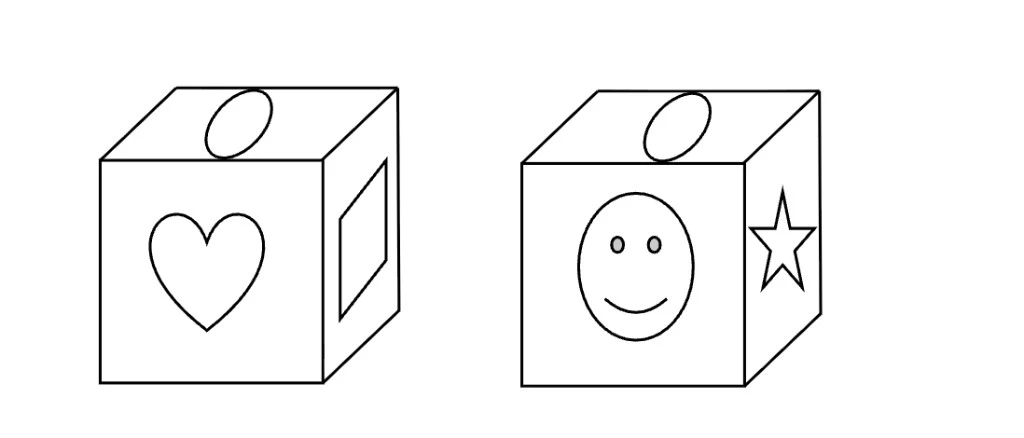
Two views of a cube are shown below. Which shape could be on the bottom side?

Question 1 · Multiple choice

Question

Two views of a cube are shown below. Which shape could be on the bottom side?

Two isometric views of the same cube. Left view: oval on top, heart on front, rectangle on right side. Right view: oval on top, smiley face on front, star on right side.

Options

  • A.Heart shape
  • B.Smiley face
  • C.Star shape
  • D.None of the above

Correct answer

D.None of the above

Explanation

Both views show the oval on top. Across the two views, five of the cube's six faces are visible: oval (top), heart, rectangle, smiley face, and star. The sixth face — the bottom, directly opposite the oval — is never seen in either view.

Since options A, B, and C show faces that are already visible elsewhere on the cube, none of them can be the bottom face.

  • A (heart): visible as the front in View 1. ✗
  • B (smiley face): visible as the front in View 2. ✗
  • C (star): visible on the right in View 2. ✗
  • D (None of the above) ✓: the bottom is the unseen sixth face.

Thinking Skills

Four friends—Leo, Mia, Ned, and Zoe—are going to the cinema. They have booked four seats in a single row, num…

Question 2 · Multiple choice

Question

Four friends—Leo, Mia, Ned, and Zoe—are going to the cinema. They have booked four seats in a single row, numbered 1, 2, 3, and 4 from left to right.

Clues:
- Zoe likes the edge and will only sit in Seat 1 or Seat 4.
- If Zoe sits in Seat 1, then Leo will sit in Seat 4.
- If Leo sits in Seat 4, then Mia will sit in Seat 3.
- Ned and Mia had an argument earlier and absolutely refuse to sit next to each other.

Options

Which one of the following statements must be true?

  • A.Zoe sits in Seat 1.
  • B.Leo sits in Seat 2.
  • C.Mia sits in Seat 1.
  • D.Ned sits in Seat 4.

Correct answer

B.Leo sits in Seat 2.

Explanation

For seating arrangement puzzles, draw a visual row of boxes. Your goal is to see if your "What-If" test forces two enemies to sit together!

Step 1: Draw the Seats

We have four seats. We keep the "Enemies Rule" (Ned and Mia) in the back of our minds as our landmine.

[ Seat 1 ]   [ Seat 2 ]   [ Seat 3 ]   [ Seat 4 ]

Step 2: The "What-If" Test (Pushing the Domino)

Look at the first rule: "Zoe will only sit in Seat 1 or Seat 4." We don't know which one, so we must run a What-If Test. We look at the "If" rules below it and see they are triggered by Zoe sitting in Seat 1.

Assumption: What if we put Zoe in Seat 1?

Let's watch the dominoes fall:

  • Domino 1: If Zoe is in Seat 1, the rules say Leo must sit in Seat 4.
  • Domino 2: If Leo is in Seat 4, the rules say Mia must sit in Seat 3.

Let's map this out on our test seats:

[ Seat 1 ]   [ Seat 2 ]   [ Seat 3 ]   [ Seat 4 ]
   ZOE         _____         MIA          LEO

Step 3: The CRASH! 💥

Look at the empty seat! Because our chain reaction filled seats 1, 3, and 4, there is only one seat left in the entire row for Ned (Seat 2). Let's put Ned in Seat 2 and look at the board:

[ Seat 1 ]   [ Seat 2 ]   [ Seat 3 ]   [ Seat 4 ]
   ZOE          NED          MIA          LEO
                 ^------------^
             (Wait... they are next to each other!)

The final rule states: "Ned and Mia... absolutely refuse to sit next to each other." By assuming Zoe sat in Seat 1, we accidentally forced Ned to sit directly next to Mia. This breaks the rules of the game. CRASH!

Step 4: The Rebound Deduction

Because assuming Zoe sat in Seat 1 caused a proximity crash, our assumption was wrong.

  • Zoe cannot sit in Seat 1. Go back to her first rule: She must sit in 1 or 4.
  • Therefore, Zoe MUST sit in Seat 4.
[ Seat 1 ]   [ Seat 2 ]   [ Seat 3 ]   [ Seat 4 ]
  _____        _____        _____         ZOE

Step 5: The Final Buffer (Solving the Leftovers)

Now we have to figure out the right answer. We have three kids left to seat: Leo, Mia, and Ned. We only have three seats left: 1, 2, and 3.

Remember the landmine: Ned and Mia refuse to sit next to each other. Look at the three empty seats. If you have three seats, and two people refuse to touch, you cannot put them in 1 and 2, and you cannot put them in 2 and 3.

The only way to keep them separated is to put them on the outsides (Seat 1 and Seat 3) and put someone else in the middle as a "buffer."

Who is the only person left to be the buffer? Leo! Leo is forced into the middle seat to keep the peace.

[ Seat 1 ]   [ Seat 2 ]   [ Seat 3 ]   [ Seat 4 ]
 MIA/NED        LEO        NED/MIA        ZOE

We don't know exactly whether Mia is in 1 or 3, and we don't care! The test writers put Option C ("Mia sits in Seat 1") in there to trick students who guess. We know with 100% logical certainty that Option B is the only absolute truth: Leo sits in Seat 2.

🧠 The "Repeatable Approach" for Spatial/Seating Puzzles

When you see a puzzle involving Seats, Floors in a Building, or Houses in a Row:

  • Draw the Physical Spaces: Draw the squares touching each other.
  • Find the "Buffer" Clue: The most important clue in these puzzles is almost always the negative one (e.g., "X cannot be next to Y").
  • Run the Domino to force a Proximity Crash: Assume the first "If" condition. Your goal is to see if the chain reaction accidentally squishes the two enemies together. Once they crash, reverse your assumption and use the "Buffer" rule to fill the remaining spaces!

Core Competencies

Additional EvidenceData SufficiencyDetecting Reasoning ErrorsDrawing a ConclusionEvaluating HypothesesFinding ProceduresIdentifying SimilarityLogical DeductionMatching ArgumentsRelevant SelectionsSeating ArrangementsSpatial ReasoningSyllogismsTruth/Liar Puzzles

Prepare with Precision

  • Build deductive logic and analytical reasoning at OC exam speed.
  • Practise argument evaluation, spatial puzzles, and multi-variable reasoning.
  • Identify which OC Thinking Skills question types need the most work.

This public page gives students and parents a detailed look at the skills and question types covered in every OC Thinking Skills practice test. The full 30-question timed test—with real-time scoring and detailed review—is available to enrolled members, so your child can build real confidence for the 2027 NSW Opportunity Class exam.