OC Thinking Skills Practice Test 2 — 2027 NSW Opportunity Class Exam

Sharpen deductive logic, argument evaluation, and analytical reasoning with this 30-question OC Thinking Skills practice test. Matched to the 2027 NSW Opportunity Class Placement Test format and timed to build real exam speed for Year 4/5 students.

Duration

30 Minutes

Format

2027 NSW Format

Questions

30 multiple-choice

Level

NSW OC Placement Test Level

Skills Covered in this Test

This practice test mirrors the official weightings of the NSW Department of Education exam.

The breakdown

  • Detecting Reasoning Errors: Identifying flaws, assumptions, and gaps in arguments.
  • Matching Arguments: Recognising argument structures that are parallel or equivalent.
  • Relevant Selections: Choosing the option that best supports or completes an argument.
  • Identifying Similarity: Pattern and structure comparison across cases.
  • Syllogisms: Applying categorical logic and valid inference forms.
  • Drawing a Conclusion: Logic-based deduction and inference from given premises.

Sample Questions from Test 2

The first two questions of this mock test (same order and wording as the timed exam).

Thinking Skills

This 3D shape was built using small blocks.

Question 1 · Multiple choice

Question

This 3D shape was built using small blocks.

Choose the back view of the 3D shape.
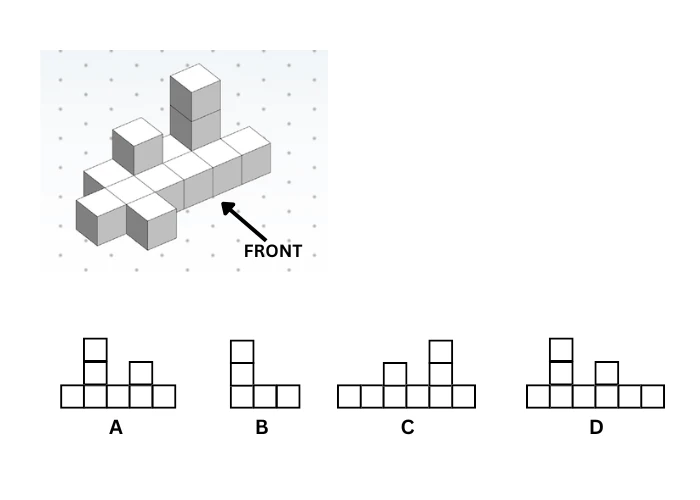
Isometric block solid with FRONT arrow and four back-view silhouettes labelled A to D

Options

  • A.A
  • B.B
  • C.C
  • D.D

Correct answer

D.D

Explanation

The FRONT arrow shows which side is the front. The back is the opposite side — imagine walking around the shape (or spinning it in your head) until you face that side. The back view is the flat “stair-step” outline you see from there: one bump for each column, as tall as that column goes. Compare A, B, C, and D. D is the only picture where every bump is the right height in the right order for the back. The others mix up heights, use too few columns, or show a tower too short or too tall.

Thinking Skills

On a standard die, opposite faces always add to 7.

Question 2 · Multiple choice

Question

On a standard die, opposite faces always add to 7.

Options

Which pair of numbers could not appear on adjacent faces (sharing an edge) of a real standard die?

  • A.2 and 4
  • B.1 and 3
  • C.3 and 4
  • D.5 and 6

Correct answer

C.3 and 4

Explanation

On a standard die, opposite faces always add to 7.

Opposite pairs on a standard die:
  1  ←──────→  6   (1 + 6 = 7)
  2  ←──────→  5   (2 + 5 = 7)
  3  ←──────→  4   (3 + 4 = 7)

Opposite faces point directly away from each other — they can never share an edge (be adjacent).

Key fact: Every other pair of faces (that is NOT an opposite pair) CAN be adjacent.

Check each option.

  • 2 and 4 → 2 is opposite 5, and 4 is opposite 3. Neither is the other's opposite partner, so these two CAN be adjacent. ✗
  • 1 and 3 → 1 is opposite 6, and 3 is opposite 4. Same reason — they CAN be adjacent. ✗
  • 3 and 4 ✓ → 3 and 4 ARE an opposite pair (3 + 4 = 7). They face directly away from each other and can never share an edge.
  • 5 and 6 → 5 is opposite 2, and 6 is opposite 1. They CAN be adjacent. ✗

Answer: 3 and 4

Core Competencies

Additional EvidenceData SufficiencyDetecting Reasoning ErrorsDrawing a ConclusionEvaluating HypothesesFinding ProceduresIdentifying SimilarityLogical DeductionMatching ArgumentsRelevant SelectionsSeating ArrangementsSpatial ReasoningSyllogismsTruth/Liar Puzzles

Prepare with Precision

  • Build deductive logic and analytical reasoning at OC exam speed.
  • Practise argument evaluation, spatial puzzles, and multi-variable reasoning.
  • Identify which OC Thinking Skills question types need the most work.

This public page gives students and parents a detailed look at the skills and question types covered in every OC Thinking Skills practice test. The full 30-question timed test—with real-time scoring and detailed review—is available to enrolled members, so your child can build real confidence for the 2027 NSW Opportunity Class exam.