OC Thinking Skills Practice Test 15 — 2027 NSW Opportunity Class Exam

Sharpen deductive logic, argument evaluation, and analytical reasoning with this 30-question OC Thinking Skills practice test. Matched to the 2027 NSW Opportunity Class Placement Test format and timed to build real exam speed for Year 4/5 students.

Duration

30 Minutes

Format

2027 NSW Format

Questions

30 multiple-choice

Level

NSW OC Placement Test Level

Skills Covered in this Test

This practice test mirrors the official weightings of the NSW Department of Education exam.

The breakdown

  • Finding Procedures: Identifying the correct sequence or steps to reach an outcome.
  • Additional Evidence: Strengthening and weakening arguments with new information.
  • Spatial Reasoning: Visualising and manipulating shapes, positions, and arrangements.
  • Seating Arrangements: Deducing who sits where from ordering and constraint clues.
  • Drawing a Conclusion: Logic-based deduction and inference from given premises.
  • Detecting Reasoning Errors: Identifying flaws, assumptions, and gaps in arguments.

Sample Questions from Test 15

The first two questions of this mock test (same order and wording as the timed exam).

Thinking Skills

Below is a side view of a solid:

Question 1 · Multiple choice

Question

Below is a side view of a solid:
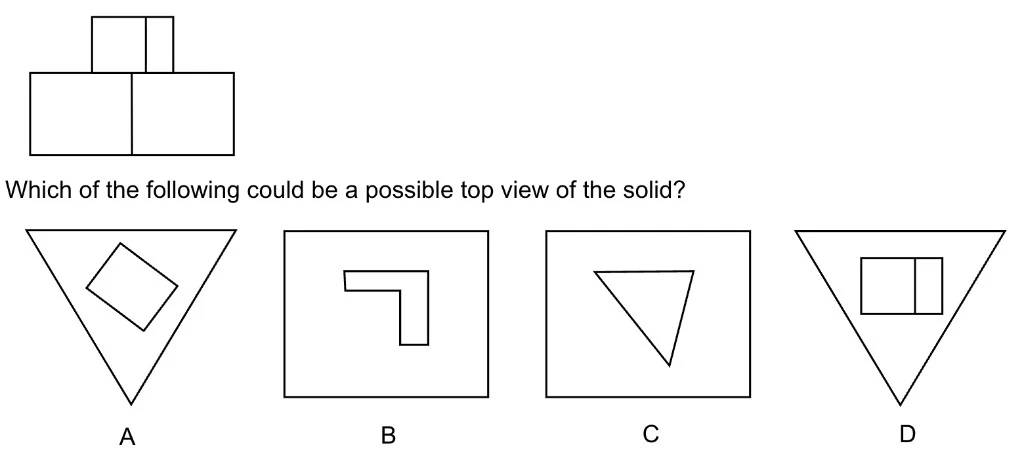
Side view of a stepped solid: a wide rectangular base with two narrower rectangles stacked on the upper-left. Below are four answer options: A (inverted triangle containing a tilted rectangle), B (square with an L-shaped bracket inside), C (square with an inverted triangle inside), D (inverted triangle with two side-by-side rectangles inside).

Options

  • A.A
  • B.B
  • C.C
  • D.D

Correct answer

A.A

Explanation

Step 1: Understand the side view.

The side view shows a stepped structure when viewed from the side:

  • A wide base spanning the full width
  • On the left side, two extra cubes are stacked upward, making the left taller than the right

This tells us the solid is like a triangular prism (with an inverted triangular base) that has a rectangular block sitting on one end of it.

Step 2: Picture what the top view would look like.

When you look straight down from above, you would see:

  • The outline of the triangular base — because the prism has an inverted triangle as its base, you see a large inverted triangle shape.
  • Inside the triangle, you would also see the footprint (outline) of the rectangular block that sits on the left end — it appears as a smaller tilted rectangle inside the triangle.

Step 3: Match to the options.

  • Option A: An inverted triangle with a small tilted rectangle inside. ✓ This matches perfectly — the large triangle is the base footprint, and the smaller rectangle is the top face of the raised block.
  • Option B: An L-shaped outline — this would require an L-shaped base, which does not match the stepped side view.
  • Option C: A triangle with only a smaller triangle inside — no rectangular block is shown, so this doesn't match.
  • Option D: An inverted triangle with two separate rectangles — this suggests a more complex two-block structure, not the single stepped profile shown.

The correct top view is Option A.

Thinking Skills

A museum has three display levels: ground, first, and second. Each level shows a different type of exhibit — …

Question 2 · Multiple choice

Question

A museum has three display levels: ground, first, and second. Each level shows a different type of exhibit — dinosaur, insect, or mineral.

  • Dinosaur exhibits are on a higher level than insect exhibits.
  • Mineral exhibits are on a higher level than insect exhibits.

Options

Which statement must be true?

  • A.The ground level has the dinosaur exhibits.
  • B.The first level has the mineral exhibits.
  • C.The second level has the insect exhibits.
  • D.The ground level has the insect exhibits.

Correct answer

D.The ground level has the insect exhibits.

Explanation

Step 1: Translate the clues into a ranking.

The two clues tell us:

  • Dinosaur is on a higher level than insect.
  • Mineral is on a higher level than insect.

So both dinosaur and mineral are above insect.

Step 2: Work out where insect must go.

There are only three levels: ground (lowest), first, second (highest).

Both dinosaur and mineral must be higher than insect. That means insect cannot be on the first or second level — it would need at least two levels below it, but there is only one level above the ground.

So insect must be on the ground level.

Second: Dinosaur or Mineral (we don't know which)
 First: Mineral or Dinosaur (we don't know which)
Ground: Insect  ← the only possibility

Dinosaur and mineral fill the first and second levels in some order, but we can't tell which is first and which is second from the clues.

Step 3: Check each statement.

  • Option A: "Ground level = dinosaur" → False, ground = insect. ✗
  • Option B: "First level = mineral" → Maybe, but mineral could equally be on the second level. Not certain. ✗
  • Option C: "Second level = insect" → False, insect is on the ground. ✗
  • Option D: "Ground level = insect" → Always true — insect must be at the bottom. ✓

The ground level must have the insect exhibits.

Core Competencies

Additional EvidenceData SufficiencyDetecting Reasoning ErrorsDrawing a ConclusionEvaluating HypothesesFinding ProceduresIdentifying SimilarityLogical DeductionMatching ArgumentsRelevant SelectionsSeating ArrangementsSpatial ReasoningSyllogismsTruth/Liar Puzzles

Prepare with Precision

  • Build deductive logic and analytical reasoning at OC exam speed.
  • Practise argument evaluation, spatial puzzles, and multi-variable reasoning.
  • Identify which OC Thinking Skills question types need the most work.

This public page gives students and parents a detailed look at the skills and question types covered in every OC Thinking Skills practice test. The full 30-question timed test—with real-time scoring and detailed review—is available to enrolled members, so your child can build real confidence for the 2027 NSW Opportunity Class exam.