OC Mathematical Reasoning Practice Test 13 — 2027 NSW Opportunity Class Exam

Strengthen problem solving, algebra, percentages, ratios, speed and distance, and geometry with this 35-question OC Mathematical Reasoning practice test. Matched to the 2027 NSW Opportunity Class Placement Test format and timed for real exam conditions.

Duration

40 Minutes

Format

2027 NSW Format

Questions

35 multiple-choice

Level

NSW OC Placement Test Level

Skills Covered in this Test

This practice test mirrors the official weightings of the NSW Department of Education exam.

The breakdown

  • Cartesian Coordinates: Plotting, distance, and reading coordinates from grids.
  • Angle Properties: Using angles on lines, triangles, and parallel lines.
  • 3D Nets: Visualising folded and unfolded solid shapes.
  • Area & Perimeter: Measuring and comparing plane figures in word problems.
  • Reflection & Rotation: Transformations and image positions on grids.
  • Symmetry: Recognising reflection and rotational symmetry in diagrams.

Sample Questions from Test 13

The first two questions of this mock test (same order and wording as the timed exam).

Mathematical Reasoning

The ratio of Adam's savings to John's savings was 9 : 4. After Adam spent \$63, the ratio became 3 : 2. How m…

Question 1 · Multiple choice

Question

The ratio of Adam's savings to John's savings was 9 : 4. After Adam spent $63, the ratio became 3 : 2. How much savings did John have?

Options

  • A.$56
  • B.$63
  • C.$72
  • D.$84
  • E.$126

Correct answer

D.$84

Explanation

Step 1: Express both savings using one variable

Original ratio Adam : John = 9 : 4.

Let Adam's savings = 9k and John's savings = 4k.

Step 2: Set up the equation for the new ratio

John's savings are unchanged (he doesn't spend anything).

After Adam spends $63:

  • Adam has: 9k − 63
  • John still has: 4k

The new ratio is 3 : 2:

(9k − 63) : 4k = 3 : 2

Step 3: Solve for k

Cross-multiply (means × extremes):

2 × (9k − 63) = 3 × 4k

18k − 126 = 12k

18k − 12k = 126

6k = 126

k = 126 ÷ 6 = 21

Step 4: Find John's savings

John = 4k = 4 × 21 = $84

Check:

  • Adam originally: 9 × 21 = $189
  • After spending: $189 − $63 = $126
  • New ratio: $126 : $84 = 3 : 2 ✓

Answer: John has $84

OptionValueWhy it is wrong
A$56Used k = 14 — solved the equation incorrectly. ✗
B$63Confused Adam's spend with John's savings. ✗
C$72Used k = 18 — arithmetic slip. ✗
D$844 × 21 = 84. ✓
E$126Found 6k = 126 but gave that as the answer instead of 4k. ✗

Mathematical Reasoning

The following solid is made of four identical cubes. Given that its volume is 32 cm³, find its total surface …

Question 2 · Multiple choice

Question

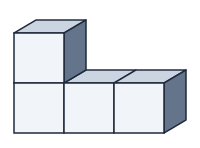
The following solid is made of four identical cubes. Given that its volume is 32 cm³, find its total surface area.

A 3-D solid made of four identical cubes arranged in an L-shape

Options

  • A.72 cm²
  • B.56 cm²
  • C.64 cm²
  • D.80 cm²
  • E.96 cm²

Correct answer

A.72 cm²

Explanation

Step 1: Find the size of each cube

4 identical cubes have a total volume of 32 cm³.

Volume per cube = 32 ÷ 4 = 8 cm³

Since a cube with edge length e has volume e³:

e³ = 8 → e = 2 cm

Each face area = 2 × 2 = 4 cm²

Step 2: Picture the L-shape arrangement

[D]
[A][B][C]

Cube D sits on top of Cube A. Cubes A, B, C are in a row along the bottom.

Step 3: Count exposed (visible) faces for each cube

Each cube has 6 faces total. Subtract faces that are glued to another cube.

CubeTouching neighboursHidden facesExposed faces
AB (right) + D (top)24
BA (left) + C (right)24
CB (left)15
DA (bottom)15

Total exposed faces = 4 + 4 + 5 + 5 = 18 faces

Step 4: Calculate the total surface area

Surface area = 18 × 4 cm² = 72 cm²

Answer: 72 cm²

Core Competencies

3D NetsAge & Rate ProblemsAlgebraic ReasoningAlgebraic SubstitutionsAngle PropertiesArea & PerimeterBefore-and-AfterCartesian CoordinatesComparing FractionsCoordinatesDecimalsFractionsFractions & RatiosGeometry & AreaGraph InterpretationGraphs & MeansInverse OperationsLogical DeductionMaps & ScaleMean, Median & ModeMental ArithmeticMixed Problem SolvingMulti-step Word ProblemsNumber PatternsNumber SequencesOrder of OperationsPercentagesPrime NumbersProbability & DiceProbability LogicProfit & LossRatiosReflection & RotationSequencesSpeed, Distance, TimeSquare & Cube NumbersSymmetryTime & CalendarsUnit ConversionsVenn DiagramsVolume & Capacity

Prepare with Precision

  • Build problem-solving speed across maths topics: percentages, ratios, algebra, and geometry.
  • Practise speed and distance, fractions, and multi-step word problems at exam pace.
  • Pinpoint the OC maths topics that need extra focus before exam day.

This public page gives students and parents a detailed look at the maths skills and question types covered in every OC Mathematical Reasoning practice test. The full 35-question timed test—with real-time scoring and detailed review—is available to enrolled members, so your child can build real confidence for the 2027 NSW Opportunity Class exam.